Home Materials
Four materials, and the honest case for each
We stock quartz, granite, marble and porcelain. Which one belongs in your kitchen depends on how you cook, how much maintenance you will actually do, and what you want to spend.
Side by side
The short version
| Property | Quartz | Granite | Marble | Porcelain |
|---|---|---|---|---|
| Origin | Engineered | Quarried | Quarried | Sintered |
| Sealing | Never | Annual | Twice yearly | Never |
| Scratch resistance | High | Very high | Moderate | Very high |
| Heat tolerance | Use a trivet | Excellent | Good | Excellent |
| Stain resistance | Excellent | Good when sealed | Etches with acid | Excellent |
| Pattern consistency | Repeats slab to slab | Every slab differs | Every slab differs | Repeats sheet to sheet |
| Sunlight | Keep out of direct sun | Stable | Stable | Stable, rated for outdoors |
| Starting price | $55 / sq ft | Ask | Ask | Ask |
Pricing varies by colour, thickness, edge profile and cutout count. Call the shop for a firm number on granite, marble and porcelain.
01Quartz
The default choice, for good reason
Quartz countertops are made by grinding natural quartz, binding it with resin and pressing it into slabs. That process produces a surface with no pores, which is why it resists staining, never needs sealing and stays hygienic around raw food.
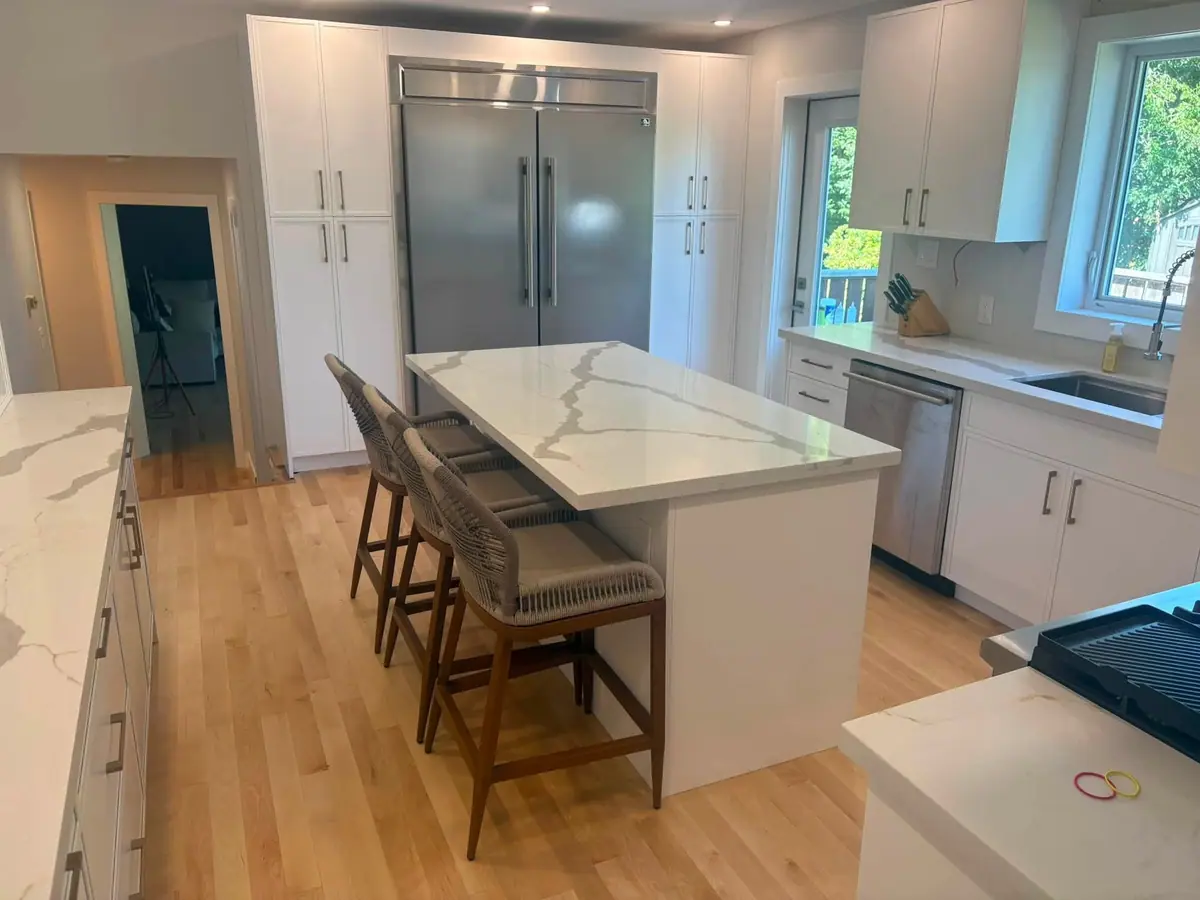
Because the pattern is engineered rather than quarried, it repeats reliably. A kitchen that needs three slabs gets three slabs that match, and the seam between the island and the perimeter run does not announce itself.
Our quartz comes through KASA Stone, a supplier with distribution across the country, and carries SGS test reports covering durability and safety. Colours run from bright calacatta veining to flat concrete greys.
The one caution: resin softens under sustained heat and fades in strong ultraviolet light. Use a trivet, and pick porcelain or granite for a sunroom island.
- Starts at
- $55 per square foot
- Thicknesses
- 2 cm and 3 cm
- Best for
- Kitchen counters, islands, vanities, full-height backsplashes

02Granite
Cut from the ground, hard as anything
Granite is an igneous rock, which is a technical way of saying it cooled slowly under enormous pressure and came out extremely hard. It shrugs off knife marks, and a pot straight off the burner does it no harm.
Every slab is different. That is either the appeal or the complication, depending on your temperament. You choose the individual slab off our rack, and what you see is what goes in your kitchen, movement and all.
Granite has pores, so it wants sealing about once a year. The test takes thirty seconds: leave a puddle of water on it for fifteen minutes, and if the stone underneath darkens, it is time to reseal.
Available polished for reflectivity or leathered for a soft matte texture that hides fingerprints, which is worth considering on a darker colour.
- Finishes
- Polished, honed, leathered
- Maintenance
- Reseal roughly once a year
- Best for
- Hard-working kitchens, outdoor counters, bar tops

03Marble
Beautiful, and it will show its age
Marble is limestone that recrystallised under heat and pressure, which gives it the translucent depth that photographs so well and that no engineered stone reproduces exactly.
It is also calcium carbonate, which reacts with acid. Lemon juice, wine, tomato and most household cleaners will leave a dull etch where they sat. Sealing slows staining but does very little about etching.
Some owners refinish periodically to keep it pristine. Others let the surface develop a patina and consider that the point. Both are reasonable. What is not reasonable is expecting marble to behave like quartz.
We often steer marble toward vanities, fireplace surrounds, feature walls and baking stations, where it stays gorgeous and stays out of the way of the tomato sauce.
- Finishes
- Polished or honed, which hides etching better
- Maintenance
- Seal twice yearly, blot spills quickly
- Best for
- Vanities, fireplaces, feature walls, pastry counters

04Porcelain
Thin sheets, extremely tough
Porcelain slabs are clay and mineral pigment fired at temperatures high enough to fuse the whole sheet solid. The result takes heat directly, resists scratching, and holds its colour under ultraviolet light.
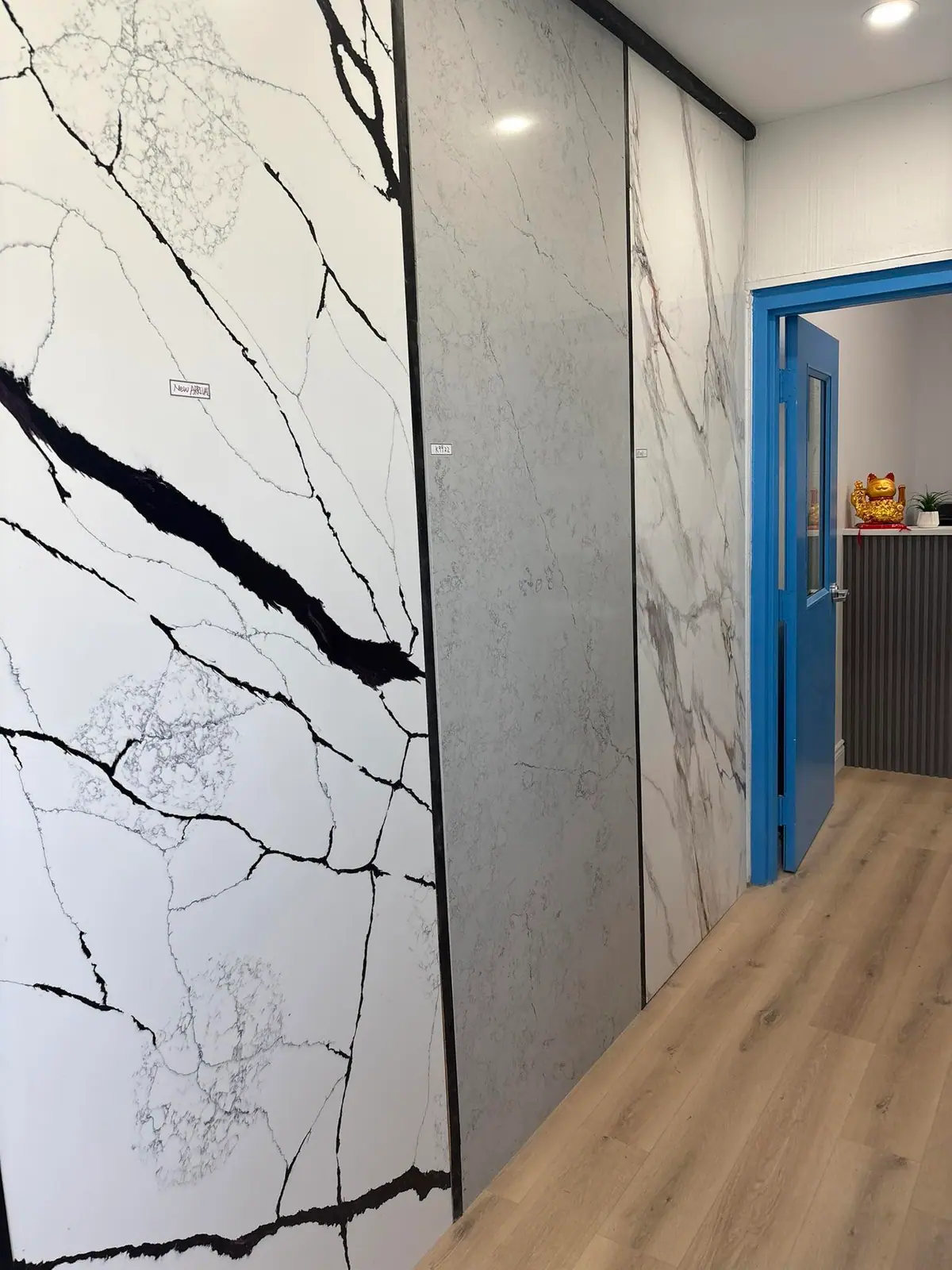
The large format is the interesting part. A single sheet can clad a fireplace from floor to ceiling or wrap a shower wall with one continuous run of veining and no grout lines interrupting it.
At 6 mm it is a cladding material. At 12 mm and 20 mm it works as a countertop. Because the pattern is printed on the face of some products rather than running through the body, the edge detail matters, and we mitre corners so the visible face carries around.
It is the right answer for outdoor kitchens and sun-drenched islands where quartz would eventually fade.
- Thicknesses
- 6 mm, 12 mm, 20 mm
- Maintenance
- None beyond ordinary cleaning
- Best for
- Feature walls, fireplaces, outdoor kitchens, shower surrounds
Detail
Edge profiles we machine
The edge changes how thick the counter reads and how it feels against your forearm. Ask to see samples of the profile before you commit.
Living with it
Care, in plain terms
Daily cleaning
Warm water, a soft cloth and a drop of dish soap handles almost everything on any of the four materials. Skip bleach, ammonia, oven cleaner and anything labelled as a descaler, particularly on marble.
Heat
Granite and porcelain take a hot pan directly. Quartz should not: the resin binder can scorch or discolour under sustained heat, and thermal shock can crack any stone near a seam or a cutout. A trivet costs less than a repair.
Cutting
All four surfaces are harder than your knives, so cutting directly on them ruins the blade long before it marks the stone. Use a board, and keep it off polished marble where grit can scuff the finish.
Sealing
Quartz and porcelain never need it. Granite wants a reseal about once a year, marble roughly twice. Test by leaving water on the surface for fifteen minutes: if the stone darkens underneath, reseal it.
Chips and repairs
Chips usually happen at a sink cutout or an exposed corner, and most can be filled with colour-matched resin so the repair disappears at arm's length. Call us with a photo before you try a hardware store kit.
Next step